



Motion sensors are everywhere, yet most people only notice them when they misbehave. A light that does not turn on, an alarm that triggers for no reason, or a remote site that stays unprotected usually points to one thing: the wrong sensor for the job. That is why understanding how motion detection really works matters.
In this blog, we will explore the seven main motion sensor types, show how each one detects movement, and explain where each performs best. Keep reading to pick the right sensor, avoid false alerts, and make your setup work for you today and get started.
What is a motion sensor, and how does it work?
A motion sensor is an infrared-based human detection sensor. Unlike factory automation sensors built to work with industrial machinery, it’s designed to be integrated into everyday devices we use. It has many domains of application. A motion sensor detects a change in its environment and uses it as a trigger. The exact “change” depends on the sensor type.

Home Construction Process concept, Security camera close up mounted on wall, capturing surroundings with clarity.
7 types of motion sensors:
Passive infrared (PIR) motion sensors:
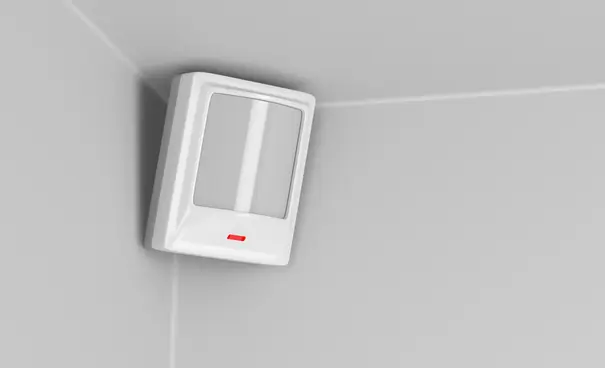
A PIR motion sensor detects movement by sensing changes in body heat from people or animals. It uses a pyroelectric element and a Fresnel lens to detect heat shifts across zones and trigger an alert or a light.
We use PIR because it’s reliable for indoor human detection and very low-power, making it ideal for security, smart homes, and motion lights. If you want a quick visual breakdown of how PIR motion sensors work, this video explains the operating principle step by step.
A PIR sensor works best in hallways, rooms, stairs, and entrances where people cross its view, but should be avoided near heat sources, direct sunlight, behind glass, or in very hot or unstable temperature areas to prevent missed motion or false alarms.

A PIR motion detector with curved dome lens, low-profile housing, and flush mounting base, isolated on transparent background.
Microwave (radar/doppler) motion sensors:
A microwave (radar/Doppler) motion sensor detects movement using radio waves, not heat. It sends out low-power microwaves and triggers when motion causes a Doppler frequency shift in the reflected signal.
We use it for wide coverage and high sensitivity, especially in large indoor spaces (warehouses, garages, high ceilings) and outdoor perimeters. We avoid it in small rooms or thin-walled areas because it can detect through obstacles and cause false alerts if sensitivity isn’t tuned.
Ultrasonic motion sensors:
Ultrasonic motion sensors detect movement using sound waves that are inaudible to humans. They emit ultrasonic pulses and analyze the returning echoes: even a small change in how those waves reflect is interpreted as motion.
They’re used because they’re excellent at picking up weak or slow movements, which makes them ideal for occupancy detection in indoor spaces like offices, meeting rooms, restrooms, or storage areas.
However, they’re less suitable outdoors or in areas with strong airflow (ventilation or air conditioning), since moving air can disrupt the echoes and reduce detection accuracy.

Dual-technology (hybrid) motion sensors:
A Dual-Technology (Hybrid) motion sensor pairs two detection methods, usually PIR + microwave or PIR + ultrasonic, and only triggers when both sense motion. This “double-check” approach makes it more reliable than a single sensor and helps reduce false alarms.
It’s especially useful when false alarms are a problem, like in outdoor areas, warehouses, or rooms with heaters and strong airflow. For simple, stable indoor spaces where a basic PIR works well, it’s often unnecessary.
Tomographic / area-mesh motion sensors:
A Tomographic / Area-Mesh motion sensor doesn’t rely on a single detector watching a room; instead, it uses several small nodes that create a radio-wave mesh across a space. When something moves through that mesh, the signal pattern shifts and the system flags motion, even if the person is behind furniture or around a corner.
We use this type when we want whole-area coverage without blind spots, especially in complex layouts or places where cameras aren’t ideal. It’s most useful for larger homes, offices, or high-security rooms, but it’s usually unnecessary for simple single-room setups because it needs multiple devices and costs more than standard sensors.
Video / AI-based motion detection sensors:
A Video / AI-based motion detection sensor uses a camera to spot movement, then software (often with AI) decides what the movement is. Instead of relying on heat or waves, it compares video frames and triggers when it sees change, and modern AI can tell the difference between a person, a car, a pet, or just shadows.
We use it when we want visual confirmation and smarter filtering, like in driveways, storefronts, parking areas, or remote monitoring sites. It’s less ideal in places with poor lighting, privacy concerns, or limited internet/power, since it needs clear video and more resources than basic motion sensors.
Vibration or shock motion sensors:
A Vibration / Tilt / Shock motion sensor detects movement by sensing when an object is shaken, lifted, tilted, or hit, rather than watching a whole room. We use it to protect things that shouldn’t move, like vehicles, doors, safes, machines, or valuable equipment, because it reacts the moment they’re disturbed. It’s most useful for anti-theft and tamper alerts, especially in remote monitoring setups.
We don’t rely on it for area coverage inside a room since it only tells us that the object moved, not that someone walked nearby.
PIR vs motion sensor: What’s the real difference in daily use?
In everyday terms, a PIR is a motion sensor, but it detects motion in a specific way.
PIR (Passive Infrared) sensor:
- Detects moving heat (people, animals).
- Great for spotting someone walking into or across an area.
- Ideal for hallways, entrances, and typical indoor security zones.
- Can miss very slow movement or someone sitting still.
“Motion sensor” (general term):
- Can mean PIR, microwave/radar, ultrasonic, dual-tech, etc.
- Some types detect motion even without heat changes, or catch tiny movements.
- Better for tricky environments or when you need higher reliability.
Bottom line:
- Need to detect someone passing through? → PIR usually does the job.
- Need to detect presence with minimal movement or in challenging conditions? → microwave/ultrasonic/dual-tech sensors are often better.
How to choose the right motion sensor type for your space?
Choosing by environment (indoor vs outdoor):
Indoors, we usually want stable, low-false-alarm detection, so PIR or ultrasonic sensors work best in rooms, hallways, and offices. Outdoors, conditions change fast (sun, wind, rain, temperature swings), so we rely more on dual-technology (PIR + microwave) or well-tuned microwave sensors for range and reliability. If the area is large or has obstacles, microwave helps; if it’s a simple indoor space, PIR is often enough.
Choosing by target (humans, pets, vehicles):
If the main target is people, PIR is the simplest and most accurate indoors. If you have pets, choose a pet-immune PIR or a dual-tech sensor to avoid false triggers from cats or dogs. For vehicles or any moving object (warm or cold), microwave or video/AI detection makes more sense, because they don’t depend on body heat and can detect motion at longer distances.
Choosing by range and sensitivity:
For short to medium range and normal walking movement, PIR is ideal. When you need longer range, wider coverage, or detection of subtle motion, microwave sensors outperform PIR. If the space is “sensor-noisy” and you still need high sensitivity without false alarms, dual-technology is the best balance, because it keeps detection strong while filtering out random triggers.
Industries that need motion sensors:
Motion sensors have moved far beyond simple home alarms. Today, we see them as a core tool for industries that need real-time awareness, safer operations, and smarter automation. From detecting intrusions to optimizing energy use and monitoring remote sites, different sectors rely on motion sensing in different ways.
In this section, we highlight the industries where motion sensors deliver the biggest value and why they have become essential.
Smart buildings and commercial real estate:
In smart buildings and commercial real estate, motion sensors help spaces run efficiently without constant manual control. They automatically manage lighting, air conditioning, access systems, and occupancy tracking in places like office towers, malls, hotels, schools, and airports.
Their real value is in reducing wasted energy by switching systems off when areas are empty, while also improving comfort by activating lights and climate control as soon as people enter.
Security and surveillance:
In security and surveillance, motion sensors act as an early warning system. The moment they detect unexpected movement, they can set off alarms and wake up cameras to record what’s happening. That’s why they’re used so widely in homes, offices, banks, warehouses, and government buildings.
They give security teams a fast, clear signal that someone is present, helping them react quickly and prevent problems before they escalate. If you’re choosing a complete alarm rather than a single sensor, see our motion sensor alarm buying guide.

A white commercial truck backs into a loading dock at a modern industrial warehouse. A security camera monitors the logistics operations and delivery process.
Industrial automation and manufacturing:
In industrial automation and manufacturing, motion sensors are essential for keeping operations safe and efficient. They track worker presence, detect machine movement, and monitor safety zones to ensure people and equipment don’t collide. We find them across factories, assembly lines, mining sites, and logistics hubs because they help automate workflows and reduce human error.
By letting machines respond instantly to movement, motion sensors strengthen Industry 4.0 systems and create smarter, safer production environments.
Healthcare and assisted living:
In healthcare and assisted living, motion sensors are used to detect patient movement, reduce fall risk, automate hands-free lighting, and monitor restricted areas. These applications of motion sensors in healthcare demonstrate their value in protecting vulnerable individuals and supporting caregivers.
They’re common in hospitals, nursing homes, rehab centers, assisted-living facilities, and home-care settings because they improve patient safety, speed up staff response, and enable remote tracking of activity patterns over time.
Retail and customer analytics:
In this field, motion sensors help stores understand and manage how people move through their spaces. They support foot-traffic counting, trigger smart security systems, automate lighting, and feed behavior analytics in places like shops, supermarkets, and showrooms.
By detecting movement in real time, they let retailers secure areas after hours while also revealing customer flow patterns during the day, which helps improve layouts, staffing, and overall shopping experience.
Causes of false alarms from motion sensors:
False motion alarms occur when a sensor detects what it interprets as movement even though there is no real threat. This is often caused by environmental factors such as heat changes from direct sunlight at sunrise or sunset, warm air from heaters or air conditioning, or strong airflow moving curtains or objects. Pets entering the detection zone can also trigger alerts, especially if the sensor sensitivity or placement is not adapted to the space.
Outdoor conditions further increase false alarms, with rain, wind, insects, and passing vehicles frequently activating sensors. The root cause lies in how motion sensors work: PIR sensors react to heat variations, microwave sensors to wave reflections, and ultrasonic sensors to echo changes.
When normal environmental activity produces signals similar to motion, and the sensor type or sensitivity is not well matched to the environment, false alerts become unavoidable
Where to place motion sensors for best coverage?
Indoor placement (best coverage):
Height: mount PIR/dual-tech sensors at 2.0 – 2.5 m high, angled slightly downward.
Best spots:
- Room corners, facing diagonally across the room.
- End of hallways, looking down the corridor.
- Stair landings / top of stairs, covering the climb and landing.
- Inside entry paths (front door → living room, garage door → kitchen), so people cross the view.
- Avoid: facing windows / sunlight, near heaters / fireplaces, directly in front of HVAC vents / fans, or behind glass. Don’t aim straight at a door for a head-on approach.
Outdoor placement (maximum security):
Height: mount at 2.5 – 3 m high to reduce tampering and widen coverage.
Best spots:
- Above front, back, and garage doors aimed across approach paths.
- Building corners to cover two sides at once.
- Driveways / parking areas, aimed across the driveway (dual-tech/microwave works best).
- Along walkways or yard access points, aimed across entry routes.
- Avoid: pointing at busy streets / sidewalks, moving trees / bushes, or low mounts under 1.8 m.
Window, door, and gate sensors:
- Use contact sensors on all exterior doors and ground-floor windows.
- Place sensor on the frame and magnet on the moving part, aligned within 1 – 2 cm when closed.
- Put a motion sensor inside the room those doors/windows open into for double coverage.
Quick ideal setup:
- Inside: hallway + living room corner + stair/landing sensor, plus door/window contacts.
- Outside: front approach + back/side yard sensors, optional driveway sensor.
Katie McEntire, a Security Writer and Safety Expert, explains in detail the best locations for installing motion sensors. Her guidance helps homeowners choose spots that improve reliability and overall security.
Motion sensors in remote monitoring systems:
Remote video monitoring reduces false alarms by adding verification and context immediately after a sensor triggers.
Here’s how that works in remote video monitoring in practice:
1. Motion sensor triggers, video confirms:
A PIR or microwave sensor only knows “something moved.” Remote video lets us check what moved. If it’s a cat, shadow, or a tree branch, we dismiss it instead of escalating. That simple “see before react” step eliminates most nuisance alerts.
2. AI filtering reduces junk alerts:
Modern video monitoring often includes AI that can recognize humans, pets, vehicles, and objects. So even if a motion sensor triggers, the system can automatically ignore non-threat events and notify us only for real risks.
3. Two-step rules (motion + video) create smarter alarms:
We can set the system so an alert only becomes an alarm when motion is detected and the camera sees a person in the zone. That dual confirmation is the same idea as dual-tech sensors, but even stronger.
4. Remote operators prevent unnecessary dispatch:
In monitored sites, a human operator can review the clip in seconds. If it’s harmless, no siren, no callout, no wasted response. If it’s real, they act fast with confidence.
5. Better tuning over time:
Video history shows patterns behind false alarms (e.g., headlights at 7pm, wind on the gate at night). With that evidence, we adjust sensor angle, sensitivity, or detection zones precisely.
Bottom line: motion sensors are great at detecting, but remote video monitoring is what makes detection accurate. Combining both turns “maybe something moved” into “we know what moved,” which dramatically reduces false alarms while keeping response speed high.
Frequently asked questions:
Are thermal motion sensors the same as PIR?
Mostly yes in everyday use. PIR sensors detect infrared heat changes, so they’re often called thermal or infrared motion sensors.
Which motion sensor triggers the fewest false alarms?
Dual-technology sensors, because they confirm motion with two methods.
Do motion detectors work through walls?
PIR doesn’t. Microwave and tomographic sensors often can, which can be useful or annoying depending on its placement.
Conclusion:
Motion detectors aren’t one-size-fits-all. The best setup depends on your environment, what you’re trying to detect, and your tolerance for false alarms. If you’re choosing for a home or small business, PIR or dual-tech covers most needs. For larger or more complex spaces, microwave, tomographic, or video-based systems can offer better coverage.
Need a motion sensor solution that actually works in your environment? Contact us without hesitation; we’re happy to help.


