

In 2026, shopping center security is no longer just about stopping shoplifting. A modern security strategy is designed to prevent incidents before they turn into insurance claims, tenant complaints, or reputational damage.
Strong security means no blind spots. Not between aisles, corridors, or staff only areas. Parking lots must feel safe and stay protected from vandalism and break ins. In this blog, we share top performing security strategies that work, along with what industry experts recommend.
When security is done right, fewer incidents and claims help protect NOI. That is the real role of shopping center security today.
Is your security strategy actually reducing risk, or just adding coverage?
NRF surveyed retail theft and violence, with 70 retail companies responding, representing 168 brands across a variety of retail sectors! In 2025, the retail industry reported increasing shoplifting, mob, smash and grabs, and even internal theft:

So how to enhance security in shopping complexes? The true measure of an effective security strategy is not the number of guards or cameras, but the actual reduction in risk over time. Forward-thinking retail property managers now track metrics such as:
- Incident frequency: monitoring reductions in theft, vandalism, or disturbances.
- Response times: faster responses correlate directly with better safety outcomes.
- Tenant and visitor satisfaction: improved perceptions of safety increase dwell time and repeat visits.
- Insurance claims and premiums: fewer incidents lead to lower costs and improved NOI.
Research confirms what top-performing retail operators already understand. Expanding camera coverage alone does not prove security value. What proves value is intelligence and how effective the emergency response planning for malls is.

Modern retail environments run on speed and accuracy. Inventory moves fast. Merchandising changes weekly. Sales data updates in real time. Security has to operate at that same tempo, with the added requirement of being effective 24/7.
When security strategies are built around data, not just devices, they do more than deter theft. This approach reduces shrinkage by identifying repeat behaviors and high risk zones. It also supports inventory reconciliation by tying incidents to time, location, and activity. Merchandising teams benefit by understanding traffic patterns, dwell times, and disruption points.
Security stops being a cost center.
It becomes a source of business intelligence that informs daily operations.
That is how retail organizations move from simply watching spaces to actively managing risk, performance, and profitability with confidence.
AI is the new trend in retail security:

At NRF 2025: Retail’s Big Show, artificial intelligence wasn’t just framed as a tool for operational efficiency; it was positioned as a core enabler of next-generation retail security.
Leading tech exhibitors emphasized how agentic AI, computer vision, and behavioral analytics are blurring the line between customer experience and protection.
For example, AI-powered digital assistants were initially built for shopper convenience. But now they are being adapted to handle emergency communications, loss prevention, and predictive threat detection in malls.
Similarly, self-checkout systems with embedded AI vision can now detect fraud and theft in real time.

Our top seven shopping center security strategies leverage AI to guide both security response and operational decision making.
Strategy #1:
AI-powered risk prediction:

The most effective shopping center security strategy starts with risk assessment.
Regular risk assessments identify where losses actually occur. Entrances versus anchor exits. Food courts versus specialty retail. Parking structures versus interior corridors. Seasonal spikes. Promotional periods. Tenant mix changes.
By reassessing risk quarterly, security leaders can align resources with real exposure rather than assumptions. AI-powered security cameras help with risk assessment through advanced monitoring.
When video data is reviewed alongside incident logs, tenant reports, and time-of-day trends, security teams gain insight into how and when shrinkage occurs. This shifts security from reactive response to proactive prevention.
When shopping centers conduct regular risk assessments and analyze quarterly security trends, they can show measurable ROI. Fewer incidents. Faster response. Clear patterns. Documented results. Security becomes a business function that can be reviewed, optimized, and justified at the executive level.
This is where retail security shifts from passive protection to operational intelligence.
Security decisions become defensible, data-driven, and budget-justified.
Strategy # 2:
Deploy layered interior and exterior surveillance coverage:

With decades of experience in security services for shopping centers, we cannot stress enough the importance of multi-layered indoor and outdoor AI-powered security cameras. They are among the most effective responses to rising theft and violence.
In 2026, 60% of retailers already plan to move to smart surveillance to improve shopping center security such as:
- License plate readers for parking lot surveillance improve visibility, detect vehicle loitering, and reduce break-ins.
- Crowd-related risks like pickpocketing, bag snatching, and aggressive behavior.
- Video monitoring flags vandalism in restrooms and common areas before damage escalates.
- Access control and video verification help manage multiple entrances and service corridors.
- Emergency detection supports faster response to fires, medical incidents, and safety threats.
- Real-time video assists in locating lost children quickly in crowded environments.
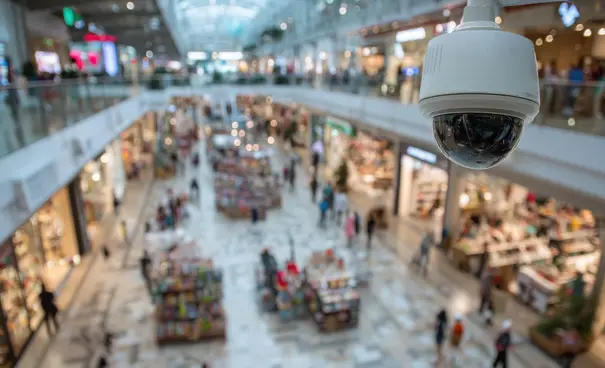
For shopping malls, this means full camera coverage of parking areas, entrances, food courts, and corridors. Every part of the property matters. Reliable 24/7 security also means coverage when risk is highest:
- During peak shopping periods and holiday seasons.
- During evenings and weekends.
- During special events and promotional traffic spikes.
- After hours, when the center is closed, but the asset remains exposed.
In our recent blog, we talk about the top anti-theft tech devices like EAS gates, anti-theft tags, ink tags, spider wraps, and smart display locks to deter theft before it starts. We are talking about security at every nook and corner of the shopping center, not just at a single store. Malls function as shared ecosystems.
Strategy #3:
Integrate AI-based video analytics for behavior and violence detection:

In 2025, retail theft was dominated by aggression, violence, and mob-style robbing with weapons. The data shows a 17 percent increase in violence against employees and a 16 percent increase in weapon involvement during theft incidents.
Swift detection of these behaviors and weapons can secure shopping centers. The CCTV cameras topped up with these advanced video analytics offer a 360 degree security:
- Gunshot detection systems to identify and locate threats instantly and support rapid emergency response.
- License plate recognition software to track vehicles involved in theft, vandalism, or repeat incidents.
- Multi-sensor parking lot and curbside surveillance towers or mobile units to protect large exterior areas and reduce vehicle-related crime.
For malls, AI is about extracting intelligence from video. Behavioral AI can detect and alert suspicious shoplifting behaviors within microseconds.
Early detection of aggressive behavior, crowd surges, or coordinated theft patterns warns shopping mall owners. In essence, the same technologies enhancing retail engagement are evolving into the backbone of proactive mall security, merging customer intelligence with situational awareness to safeguard both assets and people.
Strategy # 4:
Integrate with a centralized incident monitoring and rapid response:

Speed of response is critical in an effective security strategy. Large shopping centers benefit significantly from centralized monitoring. When CCTV cameras are integrated with advanced remote video monitoring services, response becomes immediate.
The moment an AI-enabled security camera detects a security breach, an alarm is triggered. Trained remote operators access live video to assess the situation and respond according to pre-established procedures. In many cases, a clear verbal audio intervention is enough to deter criminals and stop the incident before it escalates.
A unified command structure allows:
- Standardized response procedures.
- Consistent reporting across all zones.
- Faster escalation and decision-making.
- Reduced dependency on local staffing.
Centralization also enables leadership to see performance holistically. One dashboard. One reporting framework. One operational language across security, operations, and management.
This reduces response time and increases situational clarity during high-risk incidents.
Strategy #5:
Harden high-risk zones through environmental design:
The best security strategy uses store layout, visibility, and lighting to deter crime before it happens. Nearly 40 percent of retailers altered store layouts to deter theft, and more than half plan to continue doing so!
Conduct regular assessment of the layout to identify weaknesses. Most incidents in shopping centers occur in predictable places. Poorly lit corridors, secondary entrances, blind spots near restrooms, and parking structures create opportunity. Environmental design reduces risk by increasing visibility, limiting concealment, and making suspicious behavior easier to spot.
For malls, this translates to:
- Redesigning sightlines in corridors and common areas.
- Reducing blind spots near exits, washrooms, and secondary entrances.
- Strategically placing security desks or mobile patrol routes in known risk zones.
Environmental design remains one of the most cost-effective deterrents available.
Strategy #6:
Integration with retail operations and loss prevention:
High-performing shopping centers do not isolate security from operations. You need to integrate security with retail operations and loss prevention. It is about making security part of how a shopping center actually runs, not something that sits on the side.
Instead of reacting to theft after it happens, AI security cameras, POS data, and incident reports are connected so risks are identified as part of everyday operations. This matters because retail theft today is organized, repeated, and often hidden in operational blind spots.
Security data is hardly ever reviewed, and when it is, it is often too late. AI security cameras change that by revealing real behaviors in real time, such as repeated loitering, concealment attempts, or unusual movement patterns. POS systems flag suspicious transactions, such as excessive refunds or missed scans.

When all of this feeds into a single dashboard, security teams finally see quantifiable data instead of assumptions. Trends become visible. Risks can be measured. Decisions can be justified. Effective shopping center security programs produce clear, repeatable reports that show:
- Incident frequency trends.
- Response times.
- Verified intervention outcomes.
Security shifts from a reactive cost to an operational function that can be monitored, optimized, and explained at the executive level.
Security intelligence becomes part of daily operational decision making.
Strategy #7:
Tighter access controls:
Every person or vehicle entering or exiting a shopping mall must be validated. By connecting physical security cameras with access points not only do you get tighter controls on who enters but also implement smart access systems for restricted areas so who is allowed to move about where and where not!
RFID strengthens access control options for shopping centers by tracking what moves through them, not just who does. It improves inventory visibility, detects unpaid merchandise at shared exits, and prevents stolen goods from being resold or fraudulently returned.
When integrated with EAS, POS, and video systems, RFID turns exits into intelligent control points that reduce shrinkage and provide clear evidence for faster response and better decisions.
Giant retail brands are already using AI to reduce risk:
Artificial intelligence is no longer a future concept in retail security services. Many of the world’s largest retail brands are already using AI-driven technologies to improve mall security.
Levi Strauss & Co., for example, uses an AI-powered platform that gives store associates a complete view of shopper behavior across online and in-store channels. While designed for personalization, this same visibility helps reduce fraud and identify suspicious activity earlier.
Brands like Tapestry are using computer vision, a form of AI that analyzes video data, to understand movement, behavior, and activity inside stores. This technology supports smarter store design, improved staff awareness, and early detection of risky situations before they escalate.
Retail technology leaders such as NVIDIA enable retailers to create digital models of stores and simulate how people move through them. These AI-driven simulations allow brands to test security layouts, camera placement, and response strategies before making physical changes.
Even companies like Amazon and Nordstrom operate on unified, data-driven platforms that connect online and in-store activity. This makes it easier to spot repeat offenders, coordinated theft, and patterns that traditional security systems often miss.
The message is clear. AI is already embedded in how major brands’ mall surveillance strategies protect their stores, staff, and customers. Retailers that delay adoption are not waiting for the future. They are already behind it.
Frequently asked questions:
What is the security system in a shopping mall?
A shopping mall security system is a layered combination of security cameras, access control, alarm systems, and trained security personnel. Modern malls also use AI-powered video analytics, remote video monitoring, and real-time alerts to detect theft, loitering, and suspicious behavior across entrances, stores, parking areas, and shared spaces.
What are the best practices for mall security?
Best practices for mall security include layered protection, regular risk assessments, and data-driven decision-making. Effective malls combine AI security cameras, remote monitoring, visible deterrents, trained staff, and clear incident response procedures. Reviewing security data quarterly helps align coverage with real risks instead of assumptions.
Do shopping centers have security?
Yes, shopping centers have dedicated security systems and on-site or remote security teams. Most centers use surveillance cameras, patrols, and monitoring services to protect shoppers, tenants, and property. Many now rely on AI-powered security technology to improve detection, reduce theft, and respond faster to incidents.
Conclusion:
Retail theft and violence are escalating, coordinated, and increasingly aggressive. For shopping malls, success depends on moving beyond isolated guard coverage to shopping mall security services built as integrated, intelligence-driven, technology-enabled security ecosystems.
The most successful shopping centers use AI-driven intelligence to predict threats, focus resources, and integrate security into daily operations. When surveillance, monitoring, access control, and loss prevention work together, security shifts from a reactive cost to a measurable business function. The result is fewer incidents, faster response, more substantial tenant confidence, and protected NOI.
Shopping centers that adopt this integrated, data-driven approach are not just safer. They are more resilient, more competitive, and better prepared for what comes next.
Contact us today for a customized security solution for your shopping center.