


Intelligent video surveillance is no longer just a security tool.
When managed in the cloud instead of on local servers, you get insightful behavior analysis, cross‑camera tracking, and business intelligence for operational decision-making.
That’s VSaaS, which stands for Video Surveillance as a Service.
Cloud security and VSaaS work together to protect video systems more effectively This means cameras, users, and video access are all controlled from one secure platform.
VSaaS technologies also include continuous monitoring and encryption. Video data is protected while it is being sent and stored in the cloud. Redundancy ensures the video is not lost if one system fails.
By combining cloud security, VSaaS AI, and automation, a modern VSaaS solution lets you move faster while staying in control. They can decide who can view video, manage cameras, and respond to incidents, and exactly when they can do it.
This directly reduces risks such as unauthorized access, insider threats, and phishing attacks tied to video systems.
There’s more! Keep reading to find out more about VSaaS in detail and the real benefits of cloud video surveillance for your business.
What is VSaaS and why does it matter?
VSaaS stands for Video Surveillance as a Service. Your CCTV security cameras are no longer passively recording. VSaaS can be better understood as a video security system hosted and managed in the cloud. You do not rely on bulky on-site NVR/DVR recorders.
VSaaS uses a cloud-hosted video management system to connect IP cameras, securely transmit video, store footage at scale, and apply AI analytics. All video recording, management, and intelligence occur in the cloud, eliminating the need for on-site servers or local NVR and DVR hardware.
So why does it matter?
You do not need to buy on-site physical storage such as DVRs, NVRs, or hard drives.
Your video is being recorded, stored, and managed in the cloud by a top-notch live remote video monitoring or VSaaS provider.
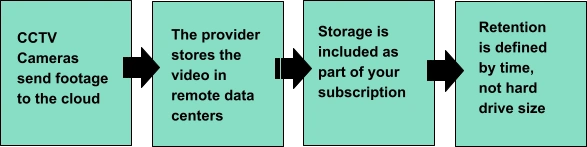
You can choose the retention period based on your needs. For example:
- 7 days of video.
- 30 days of video.
- 90 days of video.
You can view live and recorded video by paying a recurring subscription from anywhere in the world, as long as you have an internet connection.
Components of VSaaS:

Cloud video analytics enhances security cameras by using the internet to make them smarter.
As a subscription service, cloud video surveillance has providers managing the platform, storage, updates, and scaling.
While cloud video surveillance defines the technology model, VSaaS focuses on the service and business model that builds upon it.
How does Cloud Video Surveillance (VSaaS) work?
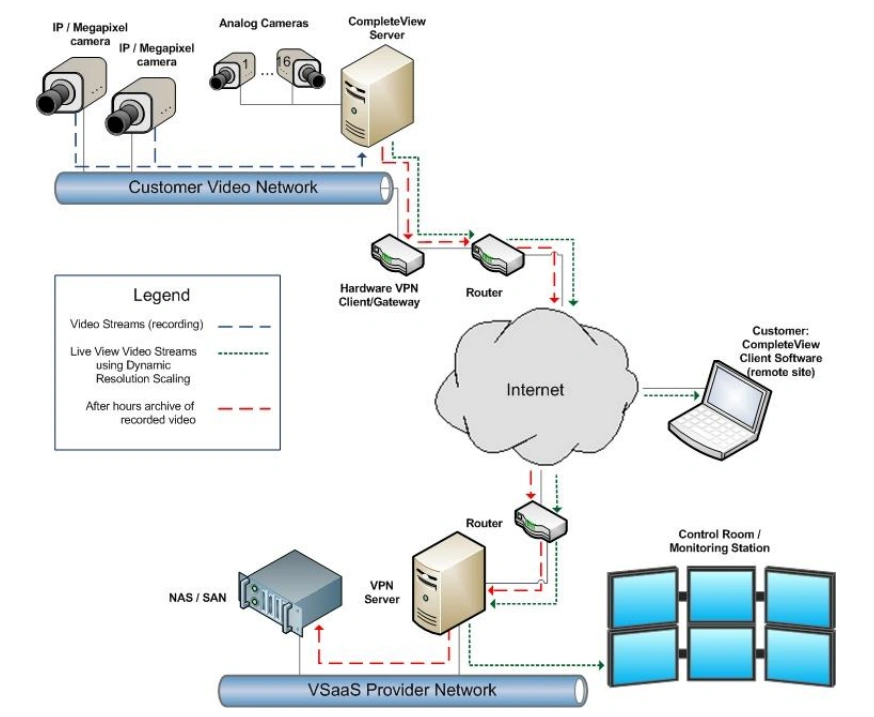
Your organization installs IP cameras on-site.
IP cameras are needed for VSaaS because they can send video and voice directly to the cloud over the internet. They allow remote recording, management, and AI analysis without relying on local DVR or NVR hardware.
The cameras connect to the internet.
The second most crucial thing is a speedy internet connection.
Video is securely streamed to the cloud rather than recorded locally.
Video is securely streamed to the cloud rather than recorded locally. Encryption protects the video while it is being transmitted. You can be sure it is free from unauthorized access or interception.
A VSaaS provider stores and manages the footage in remote data centers.
This means the video and data are protected. No third parties can see or intercept the footage.
The VSaaS provider handles updates, health monitoring, and scaling.
VSaaS platforms deliver 99.9% uptime through camera health monitoring that catches camera outages before end-users notice.
Evidence shows traditional NVR deployments lose 15–25% uptime to unpatched firmware vulnerabilities and failed drives.
Your team logs in through a web or mobile app.
Your team accesses the system through a web or mobile application. Authorized users can watch live video, review recordings, and receive alerts from anywhere. Multiple users can access the system simultaneously, depending on their permissions.
How VSaaS handles data privacy and GDPR compliance:

Modern VSaaS platforms are built to be secure and GDPR compliant. They automatically protect video data without manual work.
Video is always encrypted:
- The video is locked while being sent over the internet.
- Video stays locked while stored in the cloud.
- Only authorized users can view it.
This keeps the video safe from unauthorized access.
Access is tightly controlled:
- Users only see what their role allows.
- Multi-factor authentication protects accounts.
- Shared or stolen passwords are harder to use.
Every action is logged, including:
- Logins.
- Video viewing.
- Video downloads.
This makes it easy to see who did what and when. The VSaaS provider signs a data protection agreement, where customers can choose EU data storage locations, and video retention rules are set automatically.
Canada PIPEDA and video data:
Canada’s primary federal privacy law for private organizations is the Personal Information Protection and Electronic Documents Act (PIPEDA). PIPEDA governs how businesses collect, use, and disclose personal information in the course of commercial activities.
Under PIPEDA, organizations must:
- Limit collection and use of personal information to what is necessary for a lawful purpose.
- Implement appropriate safeguards to protect personal information against loss, theft, and unauthorized access, including secure storage and limited access.
- Provide transparency and rights for individuals to understand and access their personal information.
- Respect retention limits, keeping personal data only as needed for legitimate purposes.
United States: State and sector data privacy landscape:
The United States does not have a single comprehensive national privacy law like the GDPR. Instead, data privacy is regulated through a patchwork of federal and state laws that apply based on the type of data, the industry, and jurisdiction.
Key components of the U.S. privacy landscape include:
Such as the California Consumer Privacy Act (CCPA) and California Privacy Rights Act (CPRA), which focus on consumer rights and data control at the state level.
- Sector-specific federal laws.
HIPAA for protecting health information. GLBA for financial institutions’ customer data.
This helps meet legal and privacy requirements.
VSaaS vs. VMS:
VMS stands for Video Management System. A VMS is a software-based platform that is used to:
- Show live video from cameras.
- Record and store video footage.
- Let users search and replay past videos.
- Send alerts when something unusual happens.
- Manage who can access the video.
It lacks modern VSaaS capabilities like AI search, cross-site analytics, and real-time intervention. VSaaS is a video surveillance system moved to the cloud.
It is a different way of thinking about where value in video security comes from. Chris Cullen Business development director says:
“With VMS, every change means IT work. New servers, storage planning, upgrades. With VSaaS, changes are mostly settings. You add cameras or features by updating a subscription.”
So:
- If you need to move fast, open new sites, or change often, VSaaS removes friction.
- If you must keep everything local for legal, military, or government reasons, VMS gives that control.
But if your edge comes from quickly adopting new analytics (e.g., new retail shrink patterns, new safety detection models), VSaaS’s ability to push updated models overnight to thousands of sites is strategically more valuable than bespoke configurability.
Which one should you choose, VMS or VSaaS?
| Category | VMS (Video Management System) | VSaaS (Video Surveillance as a Service) |
|---|---|---|
| System type | On-site video system | Cloud-based video system |
| Where is the video stored | On local servers inside the building | In secure cloud data centers |
| Required hardware | Servers, NVRs, storage, power, cooling | Minimal on-site hardware |
| Upfront cost | High upfront investment | High upfront cost |
| Payment model | One-time purchase plus maintenance | Monthly or yearly subscription |
| Scalability | Difficult and expensive to expand | Easy to scale up or down |
| Installation | Complex and time-consuming | Fast and often plug-and-play |
| Maintenance | Handled by in-house IT or vendors | Handled by the service provider |
| Remote access | Requires VPN and extra setup | Accessible from any internet device |
| Internet dependency | Can record without internet | Requires internet for cloud storage |
| Risk of data loss | Higher due to theft or damage | Lower due to encrypted cloud storage |
| AI and analytics | Limited or requires add-ons | Built-in advanced AI analytics |
VSaaS helps businesses save money compared to traditional video systems. So, we are saying companies spend less overall when they use cloud video instead of on-site servers.
Recent studies from the security industry show that VSaaS reduces total costs by 30-50%. This happens over time, not just in the first year.
One reason is that businesses no longer need to buy expensive NVR servers.
Reports from Technavio show that cloud subscriptions save around 30 percent over five years because there is no hardware to purchase or maintain. This is the reason we see a lot of businesses shifting to VSaS:
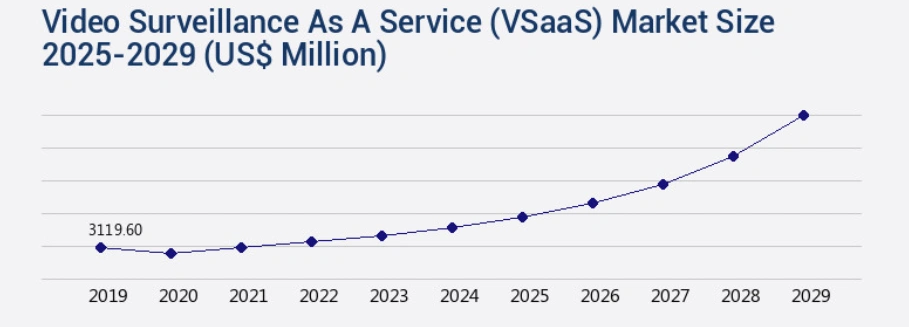
What are the main benefits of VSaaS?
- VSaaS helps you scale without new hardware headaches.
- VSaaS shifts costs from big upfront bills to predictable monthly payments.
- VSaaS gives secure access from anywhere for teams and partners.
- VSaaS AI adds another layer of protection and efficiency.
VSaaS helps you scale without new hardware headaches:
No matter how many cameras you add or remove on the site, simple subscription changes will give you the same surveillance. No need to make complex on-premises storage redesigns.
Industry leaders like Verkada report customers scaling from 10 to 500+ cameras across states without server procurement or rack space planning, as confirmed by Omdia market analysis.
Cloud providers automatically allocate elastic storage and compute resources. When a retail chain opens new stores or a logistics firm adds warehouses, operators just update camera counts in the dashboard.
This means: no data center visits, no hardware shipping delays, no IT re-architecture. This agility gives growing enterprises a massive competitive edge over legacy NVR systems that require 6-12 month upgrade cycles
VSaaS shifts costs from big upfront bills to predictable monthly payments:
VSaaS significantly reduces the total cost of video surveillance by replacing large upfront hardware purchases with predictable monthly subscriptions.
Industry analysts report a 40 to 60 percent reduction in total cost of ownership over five years, since cloud providers absorb server hardware, maintenance, and refresh cycles that traditional NVR systems require every three to five years.
VSaaS gives secure access from anywhere for teams and partners:
Remote video monitoring centers can securely view live video and recordings from any device, anywhere in the world. Unified dashboard helps the operators to investigate incidents 3 times faster even across multiple locations.
Traditional NVR systems lock video behind complex VPN setups or exposed ports that create cyber vulnerabilities. VSaaS uses browser-based access with enterprise-grade encryption (TLS 1.3), multi-factor authentication, and role-based permissions.
A GSOC analyst in Texas instantly pulls Chicago warehouse footage during a break-in, while regional managers see only their assigned stores. Third-party investigators receive time-limited secure links instead of physical drives. No more “email me the video” delays.
VSaaS AI adds another layer of protection and efficiency:
AI continuously analyzes video to detect unusual behavior, unauthorized access, or potential threats in real time.
This allows security teams to respond faster without spending all day watching screens.
Because cloud video surveillance is designed to scale and change quickly, security rules are applied consistently across all sites.
This makes it much harder for attackers to exploit gaps between locations or systems.
Choosing the right VSaaS provider:
There are different VSaaS companies because different businesses have different needs.
- Some focus on very large organizations.
- Some focus on small or flexible setups.
- Some specialize in analytics, such as license plate recognition.
- Others combine hardware and cloud software.
Why choose Sirix for VSaaS or cloud video surveillance?

- Many VSaaS companies focus on only one part of video surveillance.
- Some store video in the cloud.
- Some add AI analytics.
- Others connect access control or offer monitoring services.
Sirix Monitoring combines all of these into one cloud platform. It also adds live human operators, which most VSaaS platforms do not include.
What does Sirix include?
Sirix connects existing cameras to a single cloud command center. From one dashboard, users can access multiple features.
These include:
- Cloud video recording
- More than 20 AI analytics, such as
- Remote control of gates and doors through operators.
- Continuous system health monitoring (Ongoing remote dedicated eyes on your business following your preferred schedule).
- Live operators available 24/7.
- Voice warnings through on-site speakers.
All events and actions are tracked in one event portal.
Why this approach is better:
- With many VSaaS platforms, companies must use several vendors.
- One for video recording.
- Another for AI analytics.
- Another for live monitoring or response.
Sirix removes this complexity. Everything works together in one system.
For example:
- AI detects a suspicious vehicle.
- A live operator checks the video and license plate.
- The operator speaks through a speaker or controls a gate.
- The incident is logged automatically.
VSaaS frequently asked questions:
Is VSaaS reliable if the internet goes down?
Yes, even if the internet goes down, most platforms buffer 24-48 hours of video locally on cameras or edge gateways. The videos are then uploaded when the connection returns.
Does VSaaS work with my existing cameras?
Usually, yes, VSaaS can easily work with your existing cameras. Some leading providers like Sirix monitoring support hundreds of ONVIF camera models.
How secure is video stored in the cloud?
More secure than most NVRs. The enterprise-grade encryption (AES-256 at rest, TLS 1.3 in transit), MFA/SSO login, granular role permissions, and SOC 2 Type II compliance beat typical on-prem server configs.
What’s the minimum internet speed needed?
The minimum internet speed required for VSaaS is 4 Mbps upload, guaranteed per camera, for continuous recording. 10 cameras need approximately 40 Mbps of dedicated upload bandwidth.
Can I integrate VSaaS with access control or alarms?
Yes, an alarm is triggered during a security breach, and the event-triggered recording automatically pulls relevant camera views.
Is VSaaS compliant with privacy laws?
Yes, VSaaS is compliant with the USA privacy laws. But when configured properly, privacy masking zones, data residency controls (US-only regions), GDPR/CCPA-ready audit logs, and automated retention deletion.
Key takeaways VSaaS:
Video Surveillance as a Service (VSaaS) is a modern approach to managing security cameras in the cloud rather than on-site servers. IP cameras connect to a cloud-hosted video management system that securely sends video over the internet to a VSaaS platform.
This platform handles video storage, monitoring, and analytics, so businesses do not need to maintain complex hardware or software themselves. VSaaS software allows users to access live and recorded video from anywhere, making online video surveillance more flexible and scalable.
Overall, VSaaS technology simplifies cloud video security, lowers costs, and makes professional-grade surveillance easier to manage as organizations grow. If you need help getting started, contact us today for a free demo.