
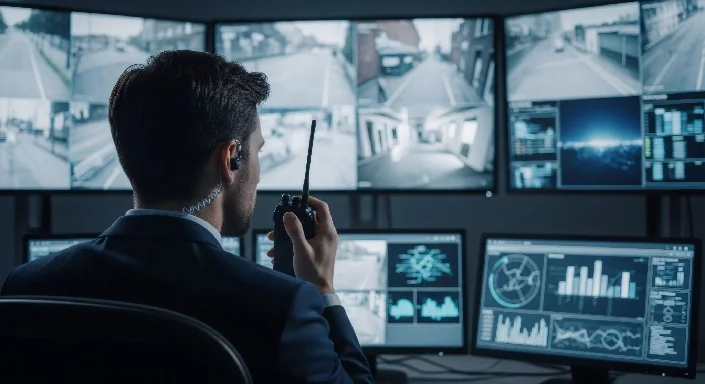


Choosing the right live video monitoring company is not just about comparing camera monitoring providers. The best company should verify real threats, reduce false alarms, support your existing camera system, document incidents clearly, and respond according to your site’s procedures.
This guide compares leading live video monitoring companies in North America, including Sirix, ECAM, Securitas, Acadian, Netwatch Systems, AvantGuard, Active Watch, and Orion. The goal is to help property owners, security managers, dealerships, construction firms, logistics sites, and commercial operators understand which provider model fits their risk, site type, and response needs.
| If you want to understand Sirix’s full live video monitoring command center model, start with the homepage. If you are looking for Sirix’s detailed service page, including AI detection, operator verification, voice-down intervention, setup, integrations, and pricing factors, visit our remote video monitoring services page. |
This article is a provider comparison guide. It explains how different companies operate, what capabilities to compare, and which provider may fit different site types. It is not the primary Sirix service landing page.
What to expect from a live video monitoring company?
Security camera monitoring companies help businesses move from passive surveillance to active event verification.
AI security cameras trigger alerts when video analytics detect suspicious behavior, intrusion, slip-and-fall incidents, loitering, violence, and more. A provider adds a response layer: trained operators review footage, assess the event, follow the site’s instructions, and escalate the situation if needed.
Depending on the provider and site setup, monitoring may include:
Real-time event verification:

Operators review video feeds when an alarm or analytics event is triggered.
Voice-down intervention:

Operators use speakers or audio devices to warn trespassers or unauthorized visitors.
Alarm video verification:

Video footage helps confirm whether a real threat, a false trigger, or normal site activity caused an alarm.
Remote access support:

Some monitoring centers can help manage gates, doors, visitors, and delivery access.
Incident reporting:
Events, operator actions, video clips, and timestamps may be documented for review.
Camera health or uptime monitoring:
Some providers can identify camera outages, connection issues, or equipment problems.
How we compared live video monitoring companies?

We compared each provider based on the factors that affect real security outcomes: monitoring coverage, operator response, camera compatibility, reporting, and site experience.
Scoring criteria:
| Criteria | Weight |
| Monitoring coverage | 20% |
| Event verification | 20% |
| System compatibility | 15% |
| Industry experience | 15% |
| Reporting and documentation | 10% |
| Response options | 10% |
| Privacy and legal fit | 10% |
1. Monitoring coverage:
Check whether the provider supports 24/7 video monitoring, after-hours monitoring, event-based monitoring, scheduled virtual guard tours, temporary site monitoring, mobile surveillance units, and alarm video verification.
The right coverage depends on when your site is most exposed: overnight, on weekends, on holidays, during delivery hours, or after closing.
2. Event verification:
A good monitoring company should explain exactly how alarms are reviewed.
Ask what triggers operator review, whether operators check live video or recorded clips, how false alarms are handled, and when police, guards, or site contacts are notified.
Fast verification matters when someone is already at the gate, fence, loading dock, parking lot, or entrance.
3. System compatibility:
Many businesses already have cameras, speakers, access control, gates, alarms, or a video management system.
Before choosing a provider, confirm whether they can connect to your existing security setup. This can reduce installation costs, speed up deployment, and make live monitoring easier to manage across a single site or multiple sites.
4. Industry experience:
Provider monitoring works best when the company understands the site.
A construction site may need perimeter monitoring and material protection. A dealership may need lot coverage and vehicle protection. A truck yard may need gate activity, trailer movement, and cargo visibility.
Look for experience with your property type: construction, automotive dealerships, truck yards, parking lots, commercial buildings, retail, multi-family residential, industrial sites, cannabis facilities, logistics, or distribution.
5. Reporting and documentation:
Reporting shows what happened, when it happened, and how the event was handled.
Look for event logs, video clips, operator notes, timestamps, alarm history, site statistics, and incident summaries. These records can support insurance claims, internal investigations, security reviews, and operational follow-up.
6. Response options:
Live monitoring should match the event.
Some sites need voice-down warnings. Others need call list notification, guard dispatch, police dispatch, remote gate control, incident escalation, maintenance alerts, or emergency procedures.
The provider should be able to follow site-specific rules for each camera, gate, zone, tenant, delivery area, and emergency contact.
7. Privacy and legal fit:
Video surveillance laws across different states allow its use for lawful security purposes and require the footage to be handled with care.
Before expanding monitoring, confirm signage, access to footage, retention periods, storage security, employee and visitor privacy expectations, and any applicable federal or provincial privacy requirements for your site.
Live video monitoring companies and providers to know in 2026:
With decades of security operations experience, we have curated a list of leading monitoring providers serving businesses, dealers, integrators, and commercial sites in Canada, the United States, and the broader North American market.
This is not a ranking list. It is a practical shortlist of solid providers worth comparing based on your site type, camera infrastructure, hours of coverage, operator model, reporting needs, and response procedures.
Sirix:
Sirix is a live video monitoring company serving commercial properties, construction sites, dealerships, logistics operations, multifamily properties, cannabis facilities, retail sites, and other high-risk locations across North America.
Sirix is a strong fit for businesses that need AI-assisted threat detection, trained operator verification, voice-down intervention, incident documentation, and flexible monitoring schedules. The company works with many existing camera systems, which can reduce the need for full hardware replacement.
Best for: Businesses that want a managed provider with AI detection, human verification, and real-time response.
Key strengths: AI-assisted event detection, live operator verification, voice-down intervention, existing camera compatibility, incident reporting, commercial site experience, and multi-site support.
For complete service details, visit Sirix remote video monitoring services.
Who is it for:
Businesses with high-risk sites, after-hours activity, valuable assets, gates, yards, parking areas, or multiple locations that need a provider-led monitoring program and operator-led response.
ECAM:
ECAM is a mobile surveillance and video monitoring provider serving North American businesses. The company publicly states that it was formerly known as Stealth Monitoring and ECAMSECURE and describes itself as a provider of mobile surveillance units, live monitoring, and commercial video security in America.
ECAM’s services are commonly associated with remote guarding, AI-driven detection, commercial video monitoring, mobile surveillance units, and large-scale property security. Its relationship with GardaWorld also connects the company’s video monitoring capabilities with broader physical security and guard service resources.
ECAM may be relevant for businesses comparing temporary surveillance units, AI-assisted event detection, mobile security infrastructure, and commercial property monitoring.
Who is it for:
ECAM is best for construction sites, outdoor yards, auto dealerships, logistics properties, commercial real estate, and multi-site businesses that need mobile surveillance units, live monitoring, and audio deterrence at scale.
Securitas:
Securitas is a strong fit for organizations that want live video monitoring connected to a larger security program.
Its global footprint across 44 markets, combined with guarding, electronic security, fire and safety services, remote guarding, and corporate risk management, makes it different from smaller live video monitoring providers that focus mainly on cameras and alerts.
The Securitas model is strongest for commercial, industrial, healthcare, campus, and multi-site organizations that need consistency across locations. Remote guarding adds scale through AI-supported video, trained operators, and remote response, while mobile patrols and on-site officers add physical presence when the situation calls for it.
Who is it for:
Securitas fits buyers who want live video monitoring integrated into a larger security operation, especially when access control, video, intrusion, staffing, and escalation procedures need to work together across multiple sites.
Acadian:
Acadian Monitoring Services provides video monitoring services throughout the United States. Acadian Monitoring Services is best understood as a dealer-focused monitoring partner with strong life-safety and security depth. Its credibility comes from 3 UL-listed, bi-directionally redundant central stations, TMA Five Diamond certification, and a service mix that goes beyond standard alarm monitoring: PERS, GPS fleet and asset tracking.
Acadian also states that it monitors more than 7,000 video-related devices across more than 1,000 video sites and can support both traditional and AI-based analytics.
Acadian is integration-friendly and operationally mature, with API or third-party workflow support likely handled case by case rather than through a public open developer program.
Who is it for:
Acadian works well when the dealer needs a reliable central station partner with life-safety experience, video monitoring, access control support, GPS tracking, AI video analytics, and custom integration capability.
Netwatch Systems:
Netwatch Systems provides proactive video monitoring and intelligent event review. Its North American website describes Netwatch as a provider of proactive video monitoring using a purpose-built platform, machine learning, trained intervention specialists, and real-time event response.
Netwatch’s proactive video monitoring model uses filtering software to identify unusual activity and routes alerts to intervention specialists, who can issue real-time audio warnings when needed.
Who is it for:
Netwatch may be relevant for commercial, industrial, logistics, construction, and multi-site properties that need audio deterrence and operator-led intervention before incidents escalate.
AvantGuard monitoring:
AvantGuard Monitoring provides central station monitoring services and includes interactive video monitoring as a feature. Its holy grail services include video verification to reduce false alarms, deter criminal activity, and support alarm verification for residential and commercial properties.
What makes it especially noteworthy for security professionals is the mix of wholesale monitoring, cloud monitoring, hybrid central-station services, and remote guarding, which suggests the company is aiming to serve dealers who want to grow recurring revenue across alarm, fire, PERS, and AI-assisted video workflows rather than rely on a single monitoring model.
Who is it for:
AvantGuard is especially relevant to dealers, integrators, and security providers that need wholesale or third-party monitoring infrastructure. They stand out for I-View Now for cloud-based video verification workflows.
Active Watch:
Active Watch provides video monitoring through partner and dealer channels. Active Watch describes the service as proactive camera monitoring for perimeter and interior protection, with real-time monitoring staff and a connection to local law enforcement when needed.
Ainger’s Active Watch is a worldwide video monitoring provider that uses advanced technology to deliver real-time video monitoring. It also notes that client-specific protocols are established to guide dispatch decisions during events.
Who is it for:
Active Watch may be relevant for businesses comparing real-time agent review, site-specific response protocols, and partner-delivered monitoring services.
Orion:
Orion Monitoring Corporation is a Canadian-based wholesale live video monitoring provider serving security dealers throughout North America.
Orion is described as a strong fit for security dealers and integrators across North America who want to add live video monitoring without having to build their own command center. Buyers should know they may not work with Orion directly. They may access Orion’s monitoring service through a dealer, which affects pricing, support, installation, reporting, and the customer relationship.
Who is it for:
It is a good fit for companies that already sell or install security systems and want to add live video monitoring within their existing customer relationships. Orion gives them a wholesale monitoring option without requiring them to build their own live video central station.
| Provider | Best fit | Service model | Key strengths | Region |
| Sirix | Commercial sites with active security risks. | Direct live video monitoring provider. | AI detection, live operators, voice-down, remote access, and incident reporting. | North America |
| ECAM | Large outdoor sites and multi-site properties. | Live remote monitoring and mobile surveillance provider. | Remote guarding, mobile units, AI detection, audio deterrence. | North America |
| Securitas | Enterprise and multi-site organizations. | Global security provider with remote guarding. | Guarding, electronic security, mobile patrol, access control support. | Global |
| Acadian Monitoring Services | Dealers, integrators, and central station buyers. | Dealer-focused monitoring provider. | UL-listed stations, video monitoring, life-safety depth, AI analytics support. | United States |
| Netwatch Systems | Sites needing proactive intervention. | Proactive video monitoring provider. | Event filtering, trained specialists, live audio warnings, fast intervention. | North America |
| AvantGuard Monitoring | Dealers and security providers. | Wholesale and cloud monitoring provider. | Video verification, dealer support, and hybrid central station services. | United States |
| Active Watch | Businesses are using partner-led monitoring. | Live remote monitoring through dealers and partners. | Real-time review, custom protocols, police escalation. | North America / partner-led |
| Orion Monitoring Corporation | Dealers are adding live video monitoring. | Wholesale live video monitoring provider. | Dealer-focused model, command center support, North American coverage. | Canada / North America |
Checklist: How to choose the right security camera monitoring companies.
You need to look for two key factors when assessing a provider: faster threat verification and swift response times. It’s possible only if a monitoring company has clear escalation procedures and a monitoring team that understands the site well.
A dealership does not face the same security risks as a shopping center parking lot. You cannot implement the same security response model in a construction site as you would in a truck yard. This brings us to the point of what exactly can help you decide on the efficacy of a few questions that you must ask when looking for a top-notch provider based on your security problems:
Can operators verify suspicious activity in real time?
Does the company explain what happens after an alarm is triggered?
Has the company monitored sites like yours before?
Can operators use on-site speakers to warn trespassers?
Can the provider connect to your current cameras and security systems?
Can the system detect people, vehicles, loitering, and perimeter breaches?
Does the provider verify alarms before dispatching police or guards?
Can monitoring hours match your risk hours?
Can operators follow custom rules for each zone or camera?
Does the provider send event logs, video clips, and incident summaries?
Can operators manage gates, doors, visitors, or deliveries?
Does the provider alert you when a camera or device goes offline?
Can the provider contact managers, guards, police, or a custom call list?
Does the provider explain how footage is stored, accessed, and retained?
Does the provider clearly explain what affects the final cost?
Use this checklist to evaluate providers, or speak with Sirix to map the right monitoring procedure for your site.
Frequently asked questions about the top live video monitoring companies.
What is a live video monitoring company?
A live video monitoring company watches security camera feeds, verifies threats, filters false alarms, and responds to incidents in real time. Depending on the provider, response may include voice-down intervention, escalation to site contacts, police dispatch support, and incident reporting.
What should I look for in a live video monitoring provider?
Compare providers by monitoring coverage, operator training, false alarm handling, camera compatibility, response procedures, reporting quality, industry experience, and pricing model. The best company should match your site risk, existing camera setup, and required response speed.
Is Sirix a live video monitoring company?
Yes. Sirix provides monitoring for commercial and multi-site properties across North America. Sirix combines AI-assisted detection, trained operator verification, voice-down intervention, incident reporting, and support for many existing camera systems.
What is the difference between a provider and service capabilities?
A company is the provider. The services are the actual capabilities delivered, such as AI detection, operator verification, voice intervention, reporting, and escalation. If you want Sirix’s service details, visit the remote video monitoring services page.
How much does provider monitoring cost?
Costs vary by provider, camera count, monitoring hours, site risk, response procedures, equipment, and reporting needs. For service-level pricing factors from Sirix, use the dedicated service page rather than this provider comparison.
What response options should a provider offer?
A provider should offer response options that match your risk, such as voice-down warnings, call list notification, police dispatch support, guard dispatch, remote access support, and incident reporting.
What is the difference between a live video monitoring company and an alarm monitoring company?
A camera monitoring provider verifies activity through security cameras before escalating a response. An alarm monitoring company responds mainly to alarm signals from sensors or panels, which may not show what triggered the event.
How do live video monitoring companies handle false alarms?
Operators review live video or recorded clips to confirm whether the alarm is a real threat. If it is not, they dismiss and document it. If action is needed, they follow the site’s response protocol.
Do all live video monitoring companies work with any camera brand?
No. Some providers only support specific cameras or platforms. Always confirm whether the company can connect to your existing cameras, video management system, speakers, alarms, gates, or access control devices. If you are also comparing access providers, see our list of the top access control companies.
Wrapping up:
Live video monitoring companies give businesses a way to detect suspicious activity earlier, verify events in real time, and respond with clearer instructions. The right provider should fit your site type, camera system, monitoring schedule, reporting needs, and response procedures.
Before choosing a company, compare how each provider handles operator review, false alarms, voice-down intervention, remote access, incident reporting, privacy requirements, and system compatibility. A construction site, dealership, truck yard, residential building, and commercial property each need a different monitoring setup.
Use our list as a starting point to compare North American live video monitoring providers based on your actual security risks, not only brand recognition.
Contact us today if you want help choosing the right provider model for your site.
To understand Sirix’s full live video monitoring command center model, start with the homepage. For detailed service capabilities, pricing factors, setup, and integrations, visit the remote video monitoring services page.


