
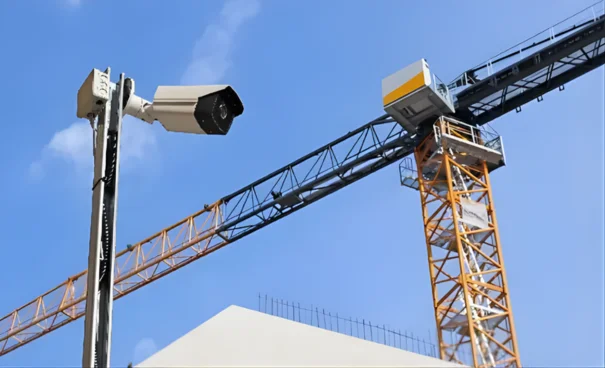


The best construction site security camera system gives you visibility into the areas where theft, vandalism, arson, and safety issues usually occur. A stronger setup connects those cameras to alerts, verification, and a fast-response plan.
After reading this guide, you might save thousands of dollars in tools, materials, and equipment theft throughout the project.
We bring you tried-and-tested camera types, features, placement options, power setups, and monitoring options that matter on an active construction site, so you can choose a security system that fits how your site actually works.
What are construction site security cameras?

Construction site security cameras monitor active job sites where the layout changes, power may be temporary, and internet access may be limited.
The mistake is choosing security cameras for a construction site based solely on model.
A camera that works at a trailer door may fail at a gate. A wide-view camera may show the full yard but miss the detail needed to identify a person, plate, or vehicle at night. The best construction site security cameras are chosen based on the risk area, not just on resolution or brand.

Why do you need jobsite security cameras in 2026?
One theft, one act of vandalism, or one fire can stop a construction project cold. Materials disappear, equipment gets damaged, crews lose working time, deadlines slip, and costs start climbing fast.
In 2025, construction site fires ripped through unfinished apartment complexes in North Las Vegas, Ogden, and Provo, destroying raw structures before they could ever open.
But fire is only one side of the risk. Organized theft rings and opportunistic criminals pose another major threat, with the National Equipment Register estimating that $300 million to $1 billion in heavy equipment is stolen annually. Theft doesn’t just interrupt a jobsite. It can erase thousands in equipment overnight, with nearly 75% of stolen construction equipment and materials never recovered.
In the U.S. alone, recent construction site theft reports include 438 pounds of explosives stolen from a Kentucky jobsite and thousands of dollars in tools taken from a Denver jobsite.
These are just a few of the problems construction site security cameras solve.
They give your team a record of what happened, who entered, when deliveries arrived, where materials were placed, and what changed overnight. When connected to live monitoring, they can also support a response while someone is still on site.
Construction site cameras are commonly used to:
- Watch gates, entrances, exits, and access roads.
- Monitor trailers, temporary offices, and storage containers.
- Protect fuel tanks, generators, equipment zones, and laydown yards.
- Detect trespassing after hours.
- Verify motion alarms before dispatch.
- Document deliveries and disputes.
- Check site progress remotely.
- Support insurance, police, and internal incident review.
- Reduce false alarms from weather, animals, shadows, and moving materials.
- The goal is clear visibility and a reliable response path.
That being said, not all construction site security cameras are equal.
Main types of construction site security cameras:
If your construction site operates 24/7, you may need a mix of construction site cameras, including fixed cameras for entrances, PTZ cameras for large open areas, thermal cameras for dark perimeters, and wireless cameras where cabling is impractical.
Sites without reliable power may also need solar-powered construction site cameras, temporary construction site security cameras, or mobile construction site cameras that can move as the project changes.
Dome cameras:

Dome security camera models are best suited for trailers, temporary offices, storage rooms, hallways, and sheltered entrances.
You get a cleaner view of access points and indoor activity, with less exposed hardware for someone to grab or knock out of place.
What dome cameras catch on a construction site:
- Verifying who entered a site trailer after hours.
- Checking who accessed the temporary office.
- Monitoring activity near a covered entrance.
- Confirming whether a subcontractor entered a restricted hallway.
- Reviewing who accessed a locked interior door.
- Checking whether materials were moved inside a storage room.
- Seeing if someone stayed inside the trailer after crews left.
- Verifying visitor, vendor, or inspector access inside the site office.
For fence lines, laydown yards, fuel tanks, and open perimeters, bullet cameras usually make more sense unless the dome is rated for harsh outdoor use.
Fixed bullet cameras:

If you need fixed coverage on a specific part of the site, bullet security cameras are usually a solid choice. They’re common on construction sites because they’re visible, weather-resistant, and easy to aim at the areas you already know need watching.
What bullet cameras can detect on construction sites:
- Capturing vehicle license plates as they pass through the main gate after hours.
- Checking whether someone approached a fuel tank.
- Confirming activity at a site trailer entrance.
- Monitoring a storage cage where copper, tools, or materials are kept.
- Watching a narrow path between the fence and the jobsite.
- Capturing movement at a delivery drop-off point.
- Watching a generator, compressor, or temporary power setup.
The upside is simple: bullet cameras are easy to position, easy to recognize as a deterrent, and built for outdoor conditions. The downside is that they only see where they’re pointed. If your site layout changes often or you need to follow movement across a larger area, you may need PTZ cameras, mobile surveillance units, or multiple fixed cameras working together.
PTZ cameras:

PTZ cameras can pan, tilt, and zoom. They can cover large areas and let operators look closer at activity when needed.
They work well for:
- Letting an operator follow someone as they move across a laydown yard.
- Zooming in on a person near a trailer after an alert triggers.
- Tracking a vehicle as it moves from the gate toward equipment zones.
- Checking whether someone is walking through the site or heading toward stored materials.
- Giving operators a closer look at activity along a long fence line.
- Moving the view from one zone to another during a live event.
- Helping operators confirm whether a person, truck, or piece of equipment belongs on site.
- Zooming in on a gate, trailer, fuel tank, or storage area when suspicious movement appears nearby.
PTZ cameras become highly useful in live video monitoring when a trained operator can move the camera during an event.
| Quick tip: They should not be the only camera watching a critical fixed point, because they may be pointed elsewhere when something happens. |
Thermal cameras:

Thermal cameras are one of the best security cameras for construction sites because they detect heat signatures even in pitch darkness. They can be useful for dark perimeters, long fence lines, wooded edges, and areas with poor lighting.
What thermal cameras catch on a construction site:
- A person walking along the large outdoor zones or fence line after hours.
- A vehicle entering a back access road with no site lighting.
- Someone hiding near trailers, stored materials, or fuel tanks.
- Movement near generators, heavy equipment, or laydown yards in pitch dark.
- Activity along wooded edges where standard cameras may only show darkness.
Thermal cameras are strong for detection, but they usually do not provide the same visual detail as standard cameras. Many sites use thermal cameras for detection and visible-light cameras for verification.
Mobile surveillance trailers:
Mobile surveillance trailers are portable units with cameras, mounting height, power, and connectivity built into one system. Many use solar power and cellular connectivity. Top-notch remote video monitoring service providers offer an autonomous security box. It is useful when the site changes often or when there is no building structure for mounting cameras.

It combines AI cameras, LTE connectivity, sirens, strobe lights, voice-down speakers, and remote monitoring in one rugged outdoor unit. That makes it a strong fit for gates, fence lines, laydown yards, fuel tanks, trailers, and equipment zones.
Battery-powered and cellular cameras:
Battery-powered LTE cameras can work where power and internet are limited. They can be placed quickly and moved as the site changes.
They work well for:
- Short-term projects.
- Remote gates.
- Temporary storage zones.
- Early construction phases.
- Small sites.
- Areas without wiring.
Battery-powered cameras need a maintenance plan. Batteries must be checked, replaced, charged, or supported with solar power.
Best camera setup by jobsite condition:
| Jobsite condition | Best camera fit | Why it works |
|---|---|---|
| No permanent power | Solar, battery, or mobile surveillance units | Keeps cameras active before utilities are ready |
| No wired internet | LTE, 5G, fixed wireless, satellite, or local recording with upload | Gives the system a way to send video, alerts, and clips |
| Large open yard | PTZ camera with fixed backup cameras | Covers wide areas while fixed cameras keep watching critical points |
| Dark perimeter | Thermal camera with visible-light verification | Detects movement and confirms visual details |
| Gate or entrance | Fixed overview camera plus LPR if needed | Captures people, vehicles, deliveries, and plates |
| High-value material storage | Fixed camera plus live monitoring | Watches the asset and the approach path |
| Changing site layout | Mobile units or repositionable wireless cameras | Moves as the project phase changes |
Power options for construction sites:
Construction site cameras need power that matches the jobsite. Some sites have network infrastructure. Others rely on temporary power, solar, or battery systems until the build is complete.
- PoE is one of the most stable options. It powers the camera and sends data through one Ethernet cable, but it needs a network switch and proper cabling.
- Solar works well for wireless deployments and remote areas. It reduces the need for trenching or fixed power, but performance depends on weather, sunlight, and system sizing.
- Battery-powered cameras are flexible and easy to move as the site changes. They work best with a clear swap or recharge schedule, so coverage does not drop unexpectedly.
- Generators can support cameras when no other power source is ready, but they should usually be treated as temporary. They need fuel, maintenance, and regular checks.
- Hybrid solar and battery systems are often the best fit for long-term remote sites. Solar charges the system during the day, while the battery keeps cameras running overnight or during poor weather.
Key features to look for in construction site security cameras:
Weather resistance:
Your construction site work needs to continue 24/7, in rain, snow, and even in the dustiest, windiest remote areas.
You need to look out for CCTV cameras with weatherproof housings and outdoor-rated cameras. Some outdoor bullet models are built for harsh conditions, with IP66/IP67, IK10, and NEMA 4X ratings, so you can count on them without adding more site visits, maintenance calls, or gaps in after hours coverage.
Night vision:
Night vision is one of the most important features for construction site video surveillance. Use night vision cameras when poor lighting or after hours activity is the issue.
It’s best for gates, fence lines, and laydown yards because it gives you usable footage when the site is dark or only partially lit. For construction managers, the benefit is faster alarm verification, fewer missed overnight events, and clearer evidence when something happens after crews leave. Check for an IR range of at least 100 feet for outdoor construction areas.
High-resolution video:
Resolution matters when you need to identify a person, vehicle, tool, or incident after something happens. Most jobsite cameras are around 1080p, 4MP, 5MP, 4K, or higher, depending on the area being monitored.
Higher resolution can give you more detail, but it won’t fix bad CCTV placement. A 4K camera mounted too high, too far back, or pointed into poor lighting can still miss the face, plate, or tool you needed to see. Lens choice, distance, compression, lighting, and angle all affect whether the footage is useful.
Match the resolution to the job: wide perimeter views require different planning than those for gates, trailers, fuel tanks, or tool storage zones.
Wide field of view:
Wide-angle cameras can cover more space, which is useful for open yards and storage areas. The tradeoff is detail. The wider the view, the smaller people and objects may appear.
Use wide-angle cameras for general awareness. Use narrower views for entrances, gates, and identification points.
Optical zoom:
Optical zoom lets the camera capture more detail at a distance without the same quality loss as digital zoom.
This matters for:
- Long driveways.
- Equipment yards.
- Gate areas.
- Remote fences.
- Large sites.
- Vehicle lanes.
PTZ cameras often use optical zoom, but fixed cameras can also be selected with lenses that match the needed distance.
Motion detection and AI analytics:
Basic motion detection can trigger alarms when movement occurs in the camera view. On a construction site, basic motion detection can create many false alarms from rain, snow, animals, moving shadows, headlights, equipment movement, or wind-blown materials.
Remote viewing:
Remote viewing allows authorized users to access cameras on a phone, tablet, or computer.
This is useful for:
- Site managers.
- Project managers.
- Owners.
- General contractors.
- Security teams.
- Operations staff.
Access should be controlled. Not every user needs every camera. Use role-based permissions when available.
Cloud or local video storage:
Construction site footage can be stored locally, in the cloud, or both.
Local storage can work well when the internet is limited. Cloud storage protects footage if the camera or recorder is stolen or damaged. A hybrid setup can give both local recording and remote backup.
When comparing storage, ask:
- How many days of footage are retained?
- Is event footage stored separately?
- Can clips be exported?
- Who can access footage?
- Is footage encrypted?
- What happens if the internet goes down?
- Are recordings stored on the camera, the recorder, the cloud, or the monitoring platform?
Tamper detection:
Tamper detection can alert the team when someone covers, moves, blocks, disconnects, or damages a camera.
This is useful for jobsites because cameras may be reachable from lifts, scaffolding, ladders, fences, or equipment.
Mobile app access:
A mobile app can make it easier to check cameras, review events, and receive alerts. For construction teams, this matters because decision-makers may be moving between offices, sites, meetings, and field visits.
The app should be easy to use and secure. Multi-factor authentication is recommended for remote access.
How to make your construction site security cameras even more powerful?
CCTV cameras, equipped with advanced video analytics, secure your construction sites by swiftly detecting anomalies. Here are a few:
- Time-lapse: You can document your site progress, deliveries, and work activities so teams can review changes and verify project milestones.
- Object detection & tracking AI: Detects and tracks people, vehicles, or equipment across camera views to help operators understand on-site movement.
- Crane climbing detection: Detects people climbing cranes after hours or without authorization, reducing trespassing and safety risk.
- License plate recognition: Captures plates at gates and access points to document deliveries, subcontractors, visitors, and unauthorized vehicles.
- Loitering detection AI: Detects people lingering near trailers, gates, fuel tanks, or stored materials before activity turns into theft or vandalism.
- Smoke & fire detection AI: Detects early signs of smoke or fire, enabling teams to respond faster before damage spreads across the site.
Now, to make these jobsite security cameras even more powerful, you need to add a proactive response by a credible remote video monitoring service provider
CCTV security cameras are useless if there is no one to verify the triggered alarms. Live-monitored construction cameras add a layer of response for such high-risk sites.
Live remote video monitoring services for construction sites.
The camera captures the event. Operators verify what is happening and follow the site’s rules for voice-down warnings, call list notification, guard dispatch, or police escalation while the person is still there.
When to choose monitored construction site cameras:
Monitored cameras are a strong fit when the site has high-value assets, repeated trespassing, after hours exposure, limited staff availability, or a history of theft.
They are also useful when the site needs documented response, not just recorded footage.
Consider monitored cameras if your jobsite has:
- Expensive tools or materials stored overnight.
- Copper, fuel, appliances, or heavy equipment on site.
- Multiple gates or access points.
- Poor lighting.
- Remote location.
- Weekend or holiday shutdowns.
- Frequent false alarms.
- Past break-ins.
- Long perimeter fencing.
- Limited overnight staff.
- Insurance or owner requirements.
Operator insight: why live monitoring matters.
First, operators verify the alarm.
| Daphnée, Remote Video Monitoring Operator at Sirix, says operators first identify the movement that triggered the alarm, then open the multiview to check nearby camera zones. |
If a person disappears between views, the operator can confirm their origin and destination using PTZ cameras, and whether they’re heading toward a trailer, fuel tank, equipment zone, or exit point. She says:
“Camera placement can make or break the response.”
Cameras aimed too low may show movement without a usable face. Cameras aimed too high may miss the detail needed to verify who entered the site.
Speed matters once police are involved.
Daphnée notes that reaching police dispatch can take up to 5 minutes, and gathering deployment details can add another 5 to 7 minutes. Clear views help operators explain what’s happening faster.
Daytime footage is not enough.
A camera can look fine during the day but fail at night due to poor lighting, power outages, wind, or camera movement. Test gates, fence lines, trailers, fuel tanks, and equipment zones at night.
Even if you have the most expensive CCTV camera. You would still need live operators to verify it, track it, issue a voice-down warning, notify the call list, dispatch a guard, or escalate to police while the person is still on site.
Internet options for construction site cameras:
Cameras need a way to send video, alerts, or clips to users and monitoring teams.
Wired internet:
Wired internet is often the most stable option when available. It may be available in a site trailer, office, or nearby building.
LTE or 5G cellular:
Cellular is common for temporary construction sites. It can support remote viewing and monitoring without a fixed internet line.
Before installing, test signal strength and upload speed at the exact camera location. A phone speed test is a start, but the router and antenna placement matter.
Fixed wireless:
Fixed wireless can work for sites where wired internet is not practical. It may require a receiver or antenna with line of sight.
Satellite internet:
Satellites can support remote job sites where wired and cellular connectivity is weak. It can be useful for rural or early-stage sites.
Confirm bandwidth, latency, weather impact, equipment location, and monthly data needs before choosing the satellite option.
Local recording with delayed upload:
Some systems record locally and upload clips when connectivity returns. This can protect footage during outages, but it does not replace live response if real-time monitoring is needed.
Where to place construction site security cameras?
Camera placement decides how useful the system will be.
A site with 12 poorly placed cameras may perform worse than a site with 6 cameras placed around real risk points.
Main entrance and exit:
The entrance should be one of the first camera locations. Capture vehicles, people, delivery activity, and after-hours access.
Use one camera for overview and another for detail if possible. A plate camera may be needed for vehicle identification.
Gates and access points:
Gates are high-risk because they control site movement. Cameras should capture both the gate itself and the approach area.
If the site uses remote gate access, camera visibility becomes even more important.
Perimeter fence lines:
Perimeter cameras help detect trespassing before someone reaches tools, trailers, or equipment.
Long fence lines may need multiple cameras, thermal detection, analytics, or mobile surveillance trailers.
Material storage areas:
Cameras should cover high-value materials such as copper, lumber, appliances, HVAC units, fixtures, fuel, and tools.
Place cameras so they capture approach paths, not only the storage pile.
Equipment parking:
Heavy equipment, generators, lifts, trailers, and machinery should be visible after hours.
A camera should capture movement around the equipment and the route someone would use to remove it.
Site trailers and offices:
Trailers often contain documents, electronics, tools, keys, plans, and communication equipment. They should have exterior camera coverage and, when appropriate, interior cameras.
Fuel tanks and generators:
Fuel theft can create direct loss and project delays. Cameras should cover tanks, hoses, generators, and access paths.
Loading and delivery zones:
Delivery hours can create confusion. Cameras can document what arrived, when it arrived, where it was placed, and who accessed it.
A good practice is to review camera views after major site changes, such as new fencing, crane changes, building envelope work, new storage areas, or a shift in site access.
Frequently asked questions for construction site cameras:
What are the best security cameras for construction sites?
The best construction site security cameras depend on the site. Fixed bullet cameras work well for gates, trailers, and storage areas. PTZ cameras work well for large open zones. Thermal cameras work well for dark perimeters. Mobile surveillance trailers work well when the site has no permanent power or mounting structure.
Do construction site security cameras need internet?
Many systems need the internet for remote viewing, alerts, cloud storage, and live monitoring. If the site has no wired internet, cameras can often use LTE, 5G, fixed wireless, satellite, or local recording with later upload.
Where should security cameras be placed on a construction site?
Place cameras at entrances, gates, fence lines, material storage areas, equipment parking zones, trailers, fuel tanks, loading areas, and other high-risk points. Review camera views as the site changes.
Do construction site cameras reduce theft?
Construction site cameras can reduce theft risk when they are visible, correctly placed, actively monitored, and connected to a response process. Recording alone may document theft after it happens. Live monitoring can trigger warnings and escalation while the event is still in progress.
What is live video monitoring for construction sites?
Live video monitoring connects construction site cameras to trained operators. When an event is triggered, operators review the video, verify what is happening, and follow the site’s response plan. That may include voice-down warnings, call list notification, guard dispatch, police dispatch, or incident documentation.
Can you rent construction site security?
Yes. Construction site security can be rented for short-term projects, remote sites, and changing jobsite layouts. You can rent temporary technical security equipment for a construction site, including cameras, mobile surveillance trailers, autonomous security boxes, sensors, speakers, lighting, and connectivity equipment.
You can also rent monitoring services, depending on what the site needs. That flexibility is the point. You can focus on one part of the setup, such as cameras or connectivity, or choose a more comprehensive security service for higher-risk sites.
Final take:
Construction site security cameras work best when they are chosen based on the jobsite, not from a generic camera list.
In this guide, we help you choose the right camera types, power source, internet connection, storage plan, and monitoring process.
A strong construction camera system should do more than record video. It should clearly show the right areas, work after hours, handle bad weather, reduce false alarms, support investigations, and connect to a response plan when someone enters the site without authorization. Sirix Monitoring provides 24/7 live video monitoring for construction sites across the US and Canada.
Contact us today for a customized construction site security solution that helps protect your equipment, materials, workers, and jobsite after hours.


